Subscriber Exchange
The Subscriber Exchange is a free, reciprocal ad exchange for Telegram channel owners. You agree to host other members' ads in your channel, and in return you can run your own ad across everyone else's. No money changes hands for a placement — the exchange runs on reciprocity, not payment.
The whole product lives at one address: https://onflowads.com/telegram/dashboard/subscriber-exchange. Every screen in the exchange — hub, channels, advertisements, the ad builder — is a view that swaps in place on that one page; nothing here has a URL of its own.
One exchange-related surface does sit elsewhere. A channel's own dashboard, reached from the dashboard's My channels list rather than from the exchange, carries that channel's hosting record: enrolment state and level, ads hosted, views and clicks delivered, credits earned, and its most recent placements. It is read-only — everything you change about the exchange is on the page above. See A channel's own dashboard.
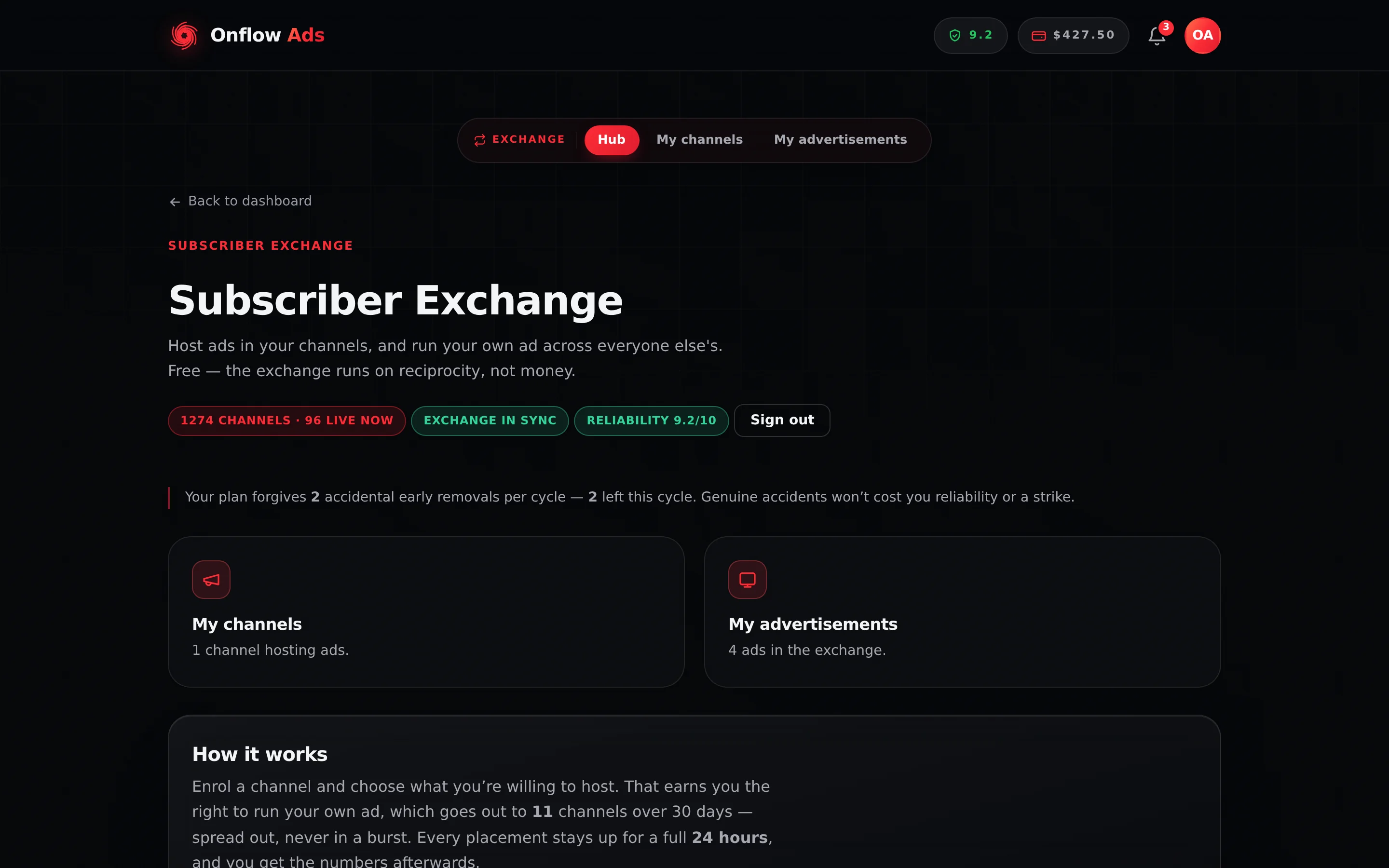
Plus plan · Advertiser. The hub, once Telegram is linked and a channel is enrolled. Look at the pill row first: the pool ticker, the bot sync status and your reliability score are the three numbers that decide what the rest of the page can do.
Who it is for
- Channel owners who want to grow. You have a public Telegram channel and want new subscribers without paying for promotion.
- Creators with an audience to trade. Your channel has real readers, and you are willing to show them the occasional relevant ad in exchange for reaching other audiences.
If you would rather pay cash for guaranteed placements instead of trading hosting for reach, that is what Paid Promotions is for. The Subscriber Exchange is the free, mutual alternative.
How it works
- Connect your Telegram account to your Onflow Ads account. One Onflow account pairs with exactly one Telegram account.
- Enrol a channel — add our bot as an administrator and choose the highest content level you are willing to host.
- Host ads. The bot posts a member's ad in your channel, leaves it up for a full 24 hours, then removes it automatically. Every placement that runs its full term earns you SubX credits.
- Run your own ad. Build an ad in the dashboard, submit it for human review, and once approved it spreads across other members' channels — spaced across a 30-day cycle, never in a burst.
The exchange is strictly host first: you cannot run an ad until at least one of your channels is enrolled and active.
It is also pool first: an ad runs only while the exchange holds enough eligible channels to carry it at your plan's cadence — one different channel per placement of the cycle. A submit the pool cannot carry is refused with nothing charged, and an approved ad whose pool later falls short is paused and resumed on its own when the pool recovers. Enrolling a channel is never restricted by this — hosting is what grows the pool. See Running ads.
The core promises
| Promise | What it means |
|---|---|
| Every placement stays up 24 hours | An ad posted in your channel comes down after exactly one day — the bot removes it itself. The same guarantee protects your ad in other channels. |
| Spread out, never bursted | A campaign's placements are spaced across the 30-day cycle. On the Free plan an ad reaches 7 channels per cycle; paid plans include more. |
| You control what you host | You pick a content level ceiling, can require per-ad approval before anything posts, and can refuse any specific ad penalty-free. |
| Both sides stay anonymous | Advertisers see totals — placements, views, clicks — never which channels ran their ad. Hosts never learn who wrote an ad they carried. The only exception is a Swap, a disclosed 1:1 trade you opt into. |
| Money never buys a host guarantee | Paid plans and one-off boosts buy capacity, targeting precision, dispatch priority and review speed — never a bypass of any host's level ceiling, weekly cap, review setting or refusal. |
| Matched for relevance and fairness | The matcher pairs ads with channels of a similar audience size, so a 500-subscriber channel is never asked to carry a 200,000-subscriber channel's ad. |
The bot is the exchange's hands and eyes inside Telegram: it posts each placement, takes it down after 24 hours, reads the views, and watches that a hosted ad is still up. Everything it observes — a placement that served its term, one pulled early, a bot demoted — it records on the website's tables; it never prices anything. The website mints your hosting credits from those records, applies every reliability move from its own published table, decides every moderation verdict, and moves every refund. Even an admin's Approve or Decline tap on a Telegram review card is relayed to the website, which makes the decision. See Rules and fair play and How credits work.
The IDs the exchange uses
The exchange has two sides — hosting and advertising — and a reference for each. All are part of the platform-wide Onflow Ads IDs scheme.
| ID | What it names | Where you'll see it |
|---|---|---|
OFSE-… | An advertisement — one campaign of yours running across the exchange | On the campaign row under My advertisements, in the Why? diagnostic, and in every confirmation about it |
OFSC-… | An enrolled channel — one of your channels signed up to host | On the channel's row under My channels, and in the enrolment confirmation |
OFSW-… | A swap — one disclosed 1:1 trade with a partner | In the Why? diagnostic on a swap campaign, for both sides — see Swaps |
The distinction that matters: OFSE- is your ad going out, OFSC- is your channel taking ads in. A question about review, reach or delivery of your own ad is an OFSE-; a question about what your channel was asked to carry, or a placement you refused, is an OFSC-.
OFS- is something else entirelyA reference beginning OFS- with no further letter is a support conversation, not an exchange campaign. The exchange always adds a letter: OFSE, OFSC, OFSW. Worth knowing when you paste one into a support message.
Because both sides of the exchange are anonymous, an ID never reveals a counterparty: quoting your OFSC- tells support which channel of yours you mean, not who wrote the ad it carried. Swaps are the exception by design — a swap is a disclosed trade, so both partners hold the same OFSW-.
What you can do from the exchange page
- Hub — your standing, the pool ticker, the set-up checklist and the review queue.
- My channels — enrol channels, see hosting activity, toggle per-ad review, refuse individual ads, or withdraw a channel.
- My advertisements — build and submit ads across four builder steps, watch placements, views and clicks land, run the Why? diagnostic, cancel, or appeal a decline.
In this section
The pages below run in reading order: set up, then host, then advertise, then credits and the paid extras, then the rules.
Getting Started
Connect your Telegram account, enrol your first channel and choose what it will host — the complete setup flow, with every error message explained.
Hosting Ads
What happens in your channel when it carries an ad, the protections that bind every placement, why a channel goes quiet, and how to read or withdraw a hosting channel.
Reviewing Ads Before They Post
Switch on per-ad approval for a channel, then approve or decline each matched ad from your review queue before anything reaches your subscribers.
Refusing an Ad
Remove an unwanted ad from your channel penalty-free and block it permanently — the safe alternative to deleting the post yourself.
Running Ads
Build, submit, track, diagnose, cancel and appeal your own ad across the Subscriber Exchange — all six builder steps, step by step.
Targeting
Builder step 3 in full — languages, countries, audience size, day-parting, scheduled starts, the competitor blocklist and the matcher controls, what each one costs you in reach, and which plan unlocks it.
AI Tools in the Exchange
The two AI entrances in the ad builder — the composer's Write my ad with AI dialog and the Targeting copilot — with their quotas, their tier gates, and exactly when an action is refunded.
Swaps
Run a direct, disclosed 1:1 cross-promotion with one partner channel instead of broadcasting to the pool — setup, the matching thresholds, what happens when it runs, and what protects you.
What the Bot Sends You
Every Subscriber Exchange event reaches you as a Telegram message from our bot — the full list, what each one tells you, and which events also send an email.
How Credits Work
What SubX credits are, how hosting mints them, how the ledger keeps your balance honest, and where the balance is readable.
Earning Credits by Hosting
The step-by-step flow for earning SubX credits — what pays, what does not, the rate for each plan, and the limits on how fast you can earn.
Delivery Boosts
The optional one-off paid upgrade for a single exchange campaign — extra placements, dispatch priority and Priority Review, what each costs, what it actually changes, and when you get your money back.
The Delivery Floor
The Ultimate plan's automatic make-good — how the 80% delivery floor is measured, how the shortfall is priced, when the sweep runs, and how the credit reaches you.
Plans, Tiers and Limits
What each subscription tier changes in the exchange — capacity, targeting, credit rate, grace and priority — and the limits that bind every member whatever they pay.
Rules and Fair Play
Every rule a Subscriber Exchange member must follow — the 24-hour promise, honest classification, the link policy, anonymity — and exactly what breaking one costs.
FAQ & Troubleshooting
Quick answers to common Subscriber Exchange questions and problems, with pointers to the page that covers each flow in full.
Next: Getting started — connecting Telegram and enrolling your first channel takes you from nothing to hosting, which is what opens the advertising side.