Policies & Trust
Onflow Ads is a marketplace: real money and real audiences change hands between people who have often never met. This section explains the rules that make that safe — the legal policies you agree to when you use the platform, and the trust systems that run in the background to protect both sides of every deal.
Who it is for
Everyone. Whether you are a channel owner selling placements, an advertiser buying them, or a creator swapping cross-promotions, the same policies and the same trust systems apply to your account.
Where to start
| If you want to… | Read |
|---|---|
| Understand what you signed up to | Terms and Conditions (summary) |
| Know what data is held about you | Privacy Policy (summary) |
| Turn advertising cookies off | Cookie preferences |
| Get money back | Refund Policy (summary) |
| Raise your trust score | Your reliability score |
| Find out why something is blocked | Account standing |
| Contest a penalty on your record | Appeals and fraud concerns |
| Report a deal that went wrong | Appeals and fraud concerns |
| Understand a 403, a rate limit or a challenge | Fraud and bot protection |
| Look up every limit and lockout, and what protects the bot, the links and the admins | Security and rate limits |
| Report a security vulnerability | Trust and safety |
These pages are summaries, not the policies
Every page in this section is a plain-language summary written to help you understand a policy quickly. None of them is the policy itself, and none of them replaces one. The complete, binding documents live on the main site and each shows a "Last updated" date at the top:
| Document | Where it lives | Length |
|---|---|---|
| Terms and Conditions | onflowads.com/terms | 33 numbered sections |
| Privacy Policy | onflowads.com/privacy | 29 numbered sections |
| Refunds and Cancellations Policy | onflowads.com/refunds | 38 numbered sections |
If anything in this section ever appears to conflict with the full legal page, the legal page governs. Where a figure is set by an operator — a fee, a floor, a quota, a window — the value shown in the product at the moment you act is the one that binds, even where a guide page quotes a different one. Terms §15.6 says so in as many words.
All three documents end with an Additional Terms section — §26 in the Terms, §27 in the Privacy Policy, §35 in the Refunds Policy — that is filled from the platform at the moment you load the page, so a clause published today binds you without waiting for a deploy. Each entry carries the date it was added. If that section is ever missing when you look, the page has degraded to the drafted document alone rather than shown you an error; reload it later to see the additions.
The one idea behind all of it
Onflow Ads runs on a simple principle: good-faith users should never be worse off for a problem that wasn't their fault, and bad-faith users should find abuse expensive.
That shows up everywhere in this section:
- Every account carries one reliability score (0 to 10), used by every engine. It rises on clean deals and falls only on confirmed misconduct — never on platform failures. Everything the platform observes in your channel feeds that same one score — what the Telegram bot sees from its admin position, and what the separate public-channel reader sees when it checks that an ad got its hours at the top. Neither is a second record.
- Every change to your score is written to a ledger you can read, and every penalty on it can be appealed to a human reviewer within 30 days. The Telegram bot never moves the number: it records what it saw, and the website prices it.
- While a fraud concern is investigated, the accused account shows as Under Review — so an unresolved accusation can't be used against anyone, and an account under investigation can't keep starting new deals. A concern that cannot be decided either way is dismissed, and nobody's score moves.
- If a review finds you were not at fault, your score is restored exactly — to the cent — as if the penalty never happened.
- Automated systems can pause money and apply published penalties. Only people resolve disputes.
- Every gate here fails open. A ban check, a rate limiter, a reliability gate and the live clause feeds all return the permissive answer when the database or the cache is unreachable. A backend fault can leave a restriction briefly unenforced; it will never lock a legitimate user out of the site.
That one score is the number every product reads before it lets you trade:
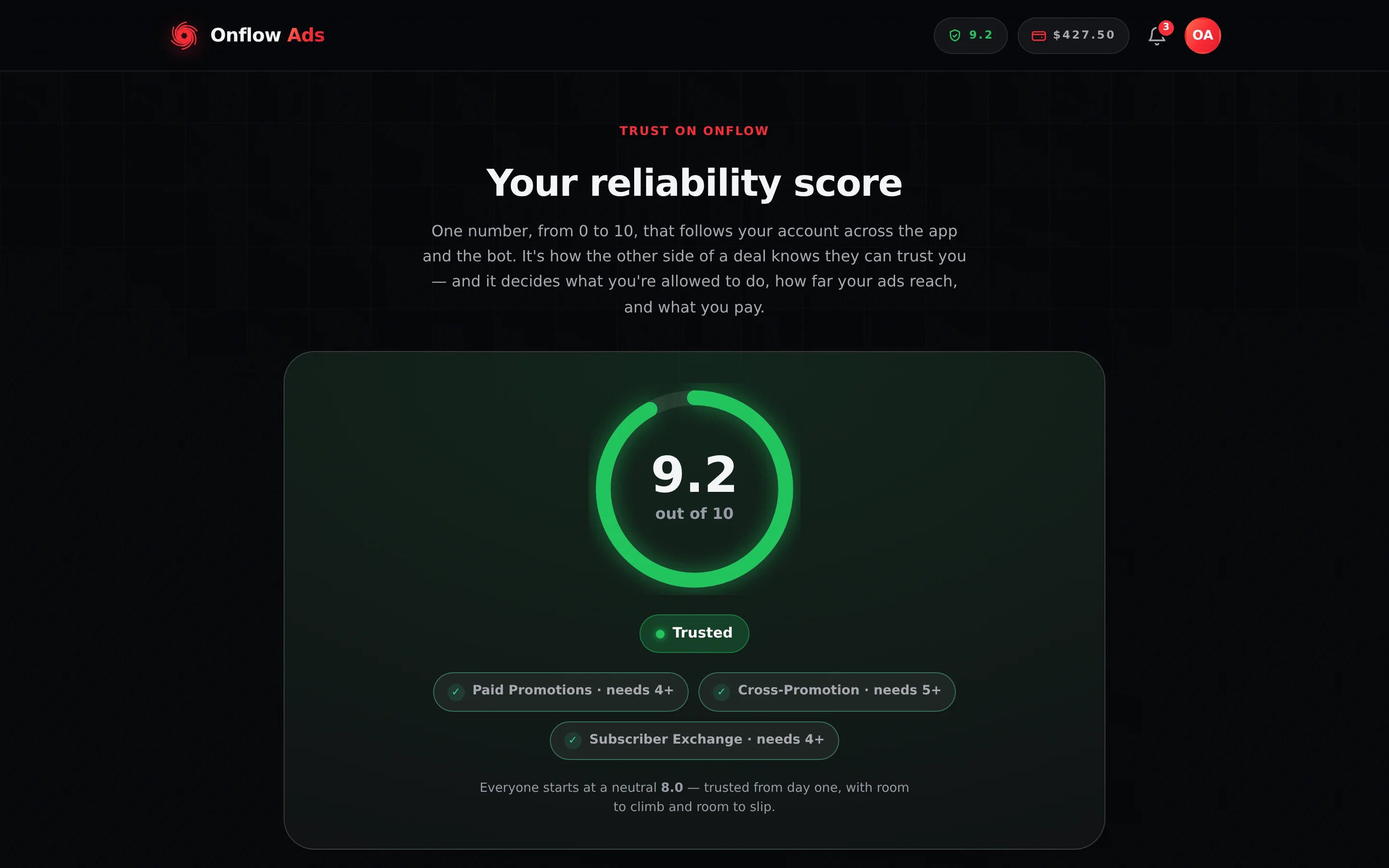
Plus plan · Advertiser. Your reliability score and the floors each marketplace requires. Look at the three chips first: a tick means that marketplace is open to you right now. Your reliability score explains every event that moves the number.
Questions?
- Email [email protected]
- Use the contact form at onflowads.com/contact, which returns an
OFM-reference you can quote - Open the help widget in the corner of any page, where support chat is switched on — it opens a ticket with its own
OFS-reference
For privacy-specific questions or to exercise your data rights, email [email protected]. For a security vulnerability, use the disclosure route in Trust and safety rather than the support queue.
The bot notifies you, publishes what the website arranged, and checks that it stayed published. It is not a support desk, it cannot take a payment, and it cannot issue a refund. Anyone messaging you on Telegram offering to resolve a complaint, unlock an account or process a refund is not us.
In this section
The three legal summaries come first, then the cookie controls, then the trust systems that decide what your account can do, then the protections and the two things you can actively do about a problem.
Terms and Conditions (summary)
A plain-language summary of the Terms and Conditions — your account, the products, payments and your wallet's two pockets, acceptable use, content, reputation and liability.
Privacy Policy (summary)
A plain-language summary of the Privacy Policy — what data is collected, why, who it is shared with, where it goes, how long it is kept, which cookies are set, and how to exercise your data rights.
Cookie preferences
Where the cookie preference centre lives, what its two categories cover, what each of the three buttons does, and why turning Marketing off reloads the page.
Refund Policy (summary)
How cancellations and refunds work for wallet top-ups, Boost orders and paid placements — with the exact steps for requesting a refund and cancelling a booking.
Your reliability score
The single 0-to-10 trust score every account carries — what moves it up and down, what it unlocks or locks, what it costs you in marketplace fees and reach, how to read your ledger, and the three ways to recover a drop.
Account standing
Every state your account can be in — good standing, Under Review, below a reliability floor, support access restricted, suspended, banned, or refused at the connection — what each one blocks and exactly how each one ends.
Appeals and fraud concerns
Step by step, how to contest a reliability penalty on your own record within the 30-day window, and how to raise a fraud concern when a paid placement went wrong — with the exact controls, windows and outcomes for each.
Prohibited content and the content check
What Onflow Ads never carries, what it always allows, how every post is checked (words, links and pictures), what a refusal or a hold looks like, and how to appeal one.
Trust and safety
How a paid placement is protected end to end — escrow, good-faith deposits, delivery proof, cancellation and moderation — where each part of the trust system is documented, and how to report a security vulnerability.
Fraud and bot protection
What the automated protections do that you can actually see — the delivery monitor, the top-of-feed exclusivity check, the cross-promotion anti-cheat, escrow and payment verification, anti-abuse rules, the anti-spam challenge, rate limits, the cross-origin guard and automated-access blocking.
Security and rate limits
Every user-facing limit and protection on Onflow Ads in plain language — the request ceilings, the per-action budgets, the sign-in and two-factor lockouts, how a developer API key is metered and what stops one working, what the Telegram bot is allowed to tell the website, how ad links are protected from inflation, the headers every page ships, and what an administrator has to prove before doing anything destructive.
Policies FAQ
Quick answers to common questions about the Onflow Ads legal policies, cookies, refunds, the reliability score, appeals, fraud protection and account standing.
Reporting a campaign
The Report button on a campaign — where it appears for a channel owner and for an advertiser, the different reasons and rules each side gets, what filing does and does not do, and when to use a dispute, a decline or a cancel instead.
Next: Terms and Conditions (summary) — the agreement behind every deal, in plain language.